


On December 11, 2025, student debtors from across the country gathered outside San Francisco’s Phillip Burton Federal Building for a key hearing in Sweet v. McMahon, presided over by Judge Alsup.
This group represented hundreds of thousands of debtors defrauded by predatory for-profit colleges. Many were promised debt cancellation by the Department of Education years ago. But delays, bureaucracy, and inaction have left them with ballooning debt and fading hope. They need relief now, not more delays, especially as the Trump administration continues to threaten to dismantle the DOE entirely.
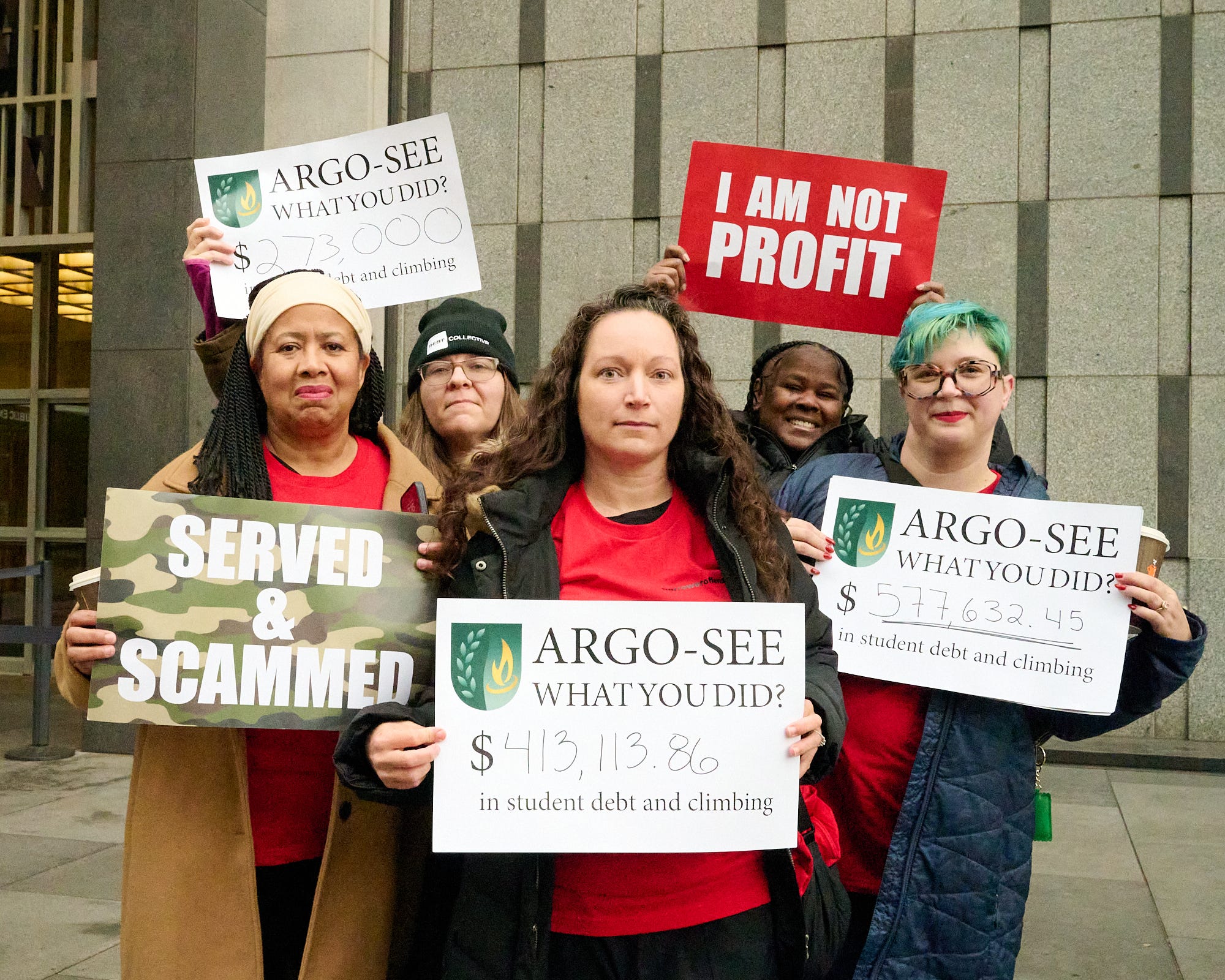
It’s no secret that student debt is notoriously hard to escape—even for borrowers who serve their communities, make consistent payments, and follow every rule. And yet, it used to be even harder. That began to change in 2014, when the collapse of Corinthian Colleges inspired organizers with the Debt Collective to share a little-known Higher Education Act program: Borrower Defense to Repayment.
Designed to cancel debt for students misled or defrauded by their schools, Borrower Defense to Repayment (BDR) gained traction as more debtors applied and won relief.
Billions in student debt have since been abolished through BDR.
Now, more than a decade later, Sweet v. McMahon—one of several cases brought by the Project on Predatory Student Lending advocating for defrauded debtors— was brought to determine whether the Department of Education will receive yet another extension to review pending BDR applications.
Why is this case so important? Because the for-profit college industry’s uniquely deceitful practices reveal a deeper problem: corruption spreads and students suffer when higher education is a profit-driven industry, instead of a public good.
We spoke with Valerie Scott, a veteran and Debt Collective organizer, about her experience with for-profit, Argosy University, and what this moment means for those still waiting for the relief they deserve.
This interview has been edited for length and clarity.
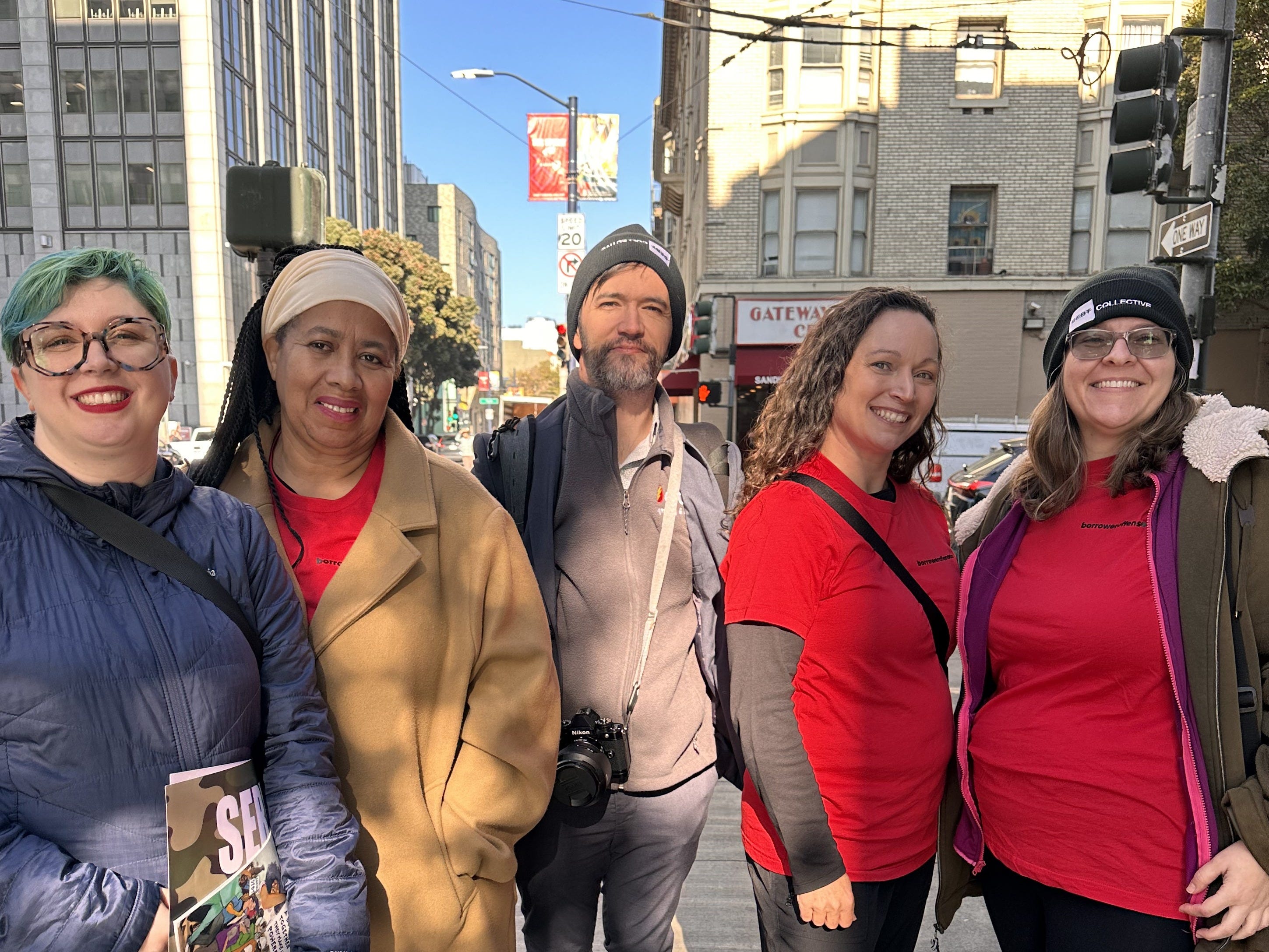
Maddy Clifford: Thank you so much for speaking with me today, Valerie. Can you share how much debt you currently owe and how it feels emotionally for you?
Valerie Scott: I owe about $411,000 in student loans and saying that number out loud is overwhelming and upsetting. I’m angry that I was taken advantage of, and that the government allowed it to happen. They knew Argosy University and other for-profit schools were lying and exploiting students and still let it go on for years.
What’s especially painful is that I’ve paid consistently for many years, and my balance has only gone up, never down. If mortgages or car loans worked like this, there would be public outrage.
Have your feelings changed from when you graduated to now?
When I graduated, I’d borrowed about $265,000. I checked my balance and thought, “Okay, this is a lot, but I can pay it off.”
A couple of years later, I checked again and saw $300,000. I was confused and started doubting myself, wondering if I’d misremembered how much I borrowed. It wasn’t until I got involved in Borrower Defense [to Repayment] and organizing that I realized I hadn’t made a mistake—the balance was designed to go up.
That’s where a lot of my anger comes from. This is government-sanctioned usury.
What makes Argosy—and for-profit universities like it—uniquely harmful?
Well, Argosy lied about the cost of their programs. Many students signed contracts saying their degree would cost $70,000–$90,000, but the real cost was way higher.
They also targeted vulnerable people, including homeless people, by promising that students could receive federal student loans, use some for tuition, and keep the rest for housing and food. In reality, Argosy took every single dollar for tuition, fees, books, and expensive required materials.
They went after people ignorant about for-profit college financing, including first-generation students like me who didn’t understand compound interest or the structure of student loans.
Argosy also had “preferred lender” relationships with companies like Sallie Mae, later Navient, and now MOHELA. The more students borrowed, the more kickbacks Argosy received from those lenders. That created a clear incentive to push students to borrow as much as possible.
How did you learn about Borrower Defense to Repayment?
I didn’t hear about Borrower Defense until June 2022, after a major lawsuit against the Department of Education (under DeVos/Cardona) was settled. A friend saw a press release naming Argosy as a bad actor school and sent it to me asking if my loans might be qualified.
I started researching, found a Facebook group, and looked at the application. It was complicated and very unclear about what exactly to include. But I did eventually submit my application in October 2022, just before the November 2022 deadline to be part of the post class.
The Project on Predatory Student Lending (PPSL) sued, and as part of the settlement, many past denials had to be reconsidered under new rules. Some borrowers who attended certain schools like Argosy received automatic loan discharge because the evidence of misconduct was so strong. While I didn’t qualify, my case must be adjudicated under the 2016 Borrower Defense rules, which are less harsh on borrowers.
So I believe we have a strong chance—if they ever finish processing our cases.
You didn’t qualify for automatic discharge because your settlement group falls in a later window, where the rules were changed and require the Department of Education to review each case individually. What’s stopping the federal government from simply canceling debt for people at proven predatory schools like Argosy?
The 2019 rules were very harsh and led to extremely high denial rates. The judge in our case said those rules were unfair and ordered that we be judged under the 2016 rules, which are much more favorable to borrowers.
We did request group cancellation for Argosy borrowers, arguing that borrowers from similar schools received group cancellation in May 2024. Senator Ed Markey, Senator Dick Durbin, and Representative Maxine Waters, wrote to President Biden on our behalf, urging him to cancel our loans.
But Argosy borrowers received no equivalent relief.
Today, Judge Alsup will consider whether or not to give the Department of Education more time to process our applications. Every delay means more interest piling up, people stuck choosing between paying loans that may be canceled, or going into forbearance and watching their balances explode.
Do people know that Argosy shut down because they stole from the federal government?
I’m not sure if people are aware that Argosy stole federal student aid, GI Bill funds, military scholarships, and VA benefits. They were supposed to take tuition out of government funds and then refund the remainder to the student. Instead, Argosy started keeping all the money.
If an individual stole federal money, they’d likely go to jail. Argosy’s higher-ups have faced no such repercussions. Many students are still paying back money that Argosy stole from the government, effectively making the scam complete. Argosy took the money, leaving students on the hook for the debt.
Why should people—even those without student debt—care about these cases?
We’re seeing a push to privatize more of higher education and student lending. When education is run for-profit, the focus shifts to shareholder return, not quality of education.
Recently, the Trump administration capped how much certain professions can borrow with federal loans. Mental health therapists and nurses are no longer treated as “professional degrees” for higher borrowing limits. They want people to believe this will force schools to lower tuition. I don’t buy that!
When students hit the federal cap, for-profit schools typically hand them an application for a private lender. Students then take out private loans with interest rates as high as 20%.
Borrower Defense to Repayment only applies to federal loans, not private ones. So once your debt is private, you’re largely stuck. You might be able to discharge some of it in bankruptcy, or you can just stop paying, wreck your credit for 7–10 years, and hope they don’t sue you.
But why should I have to ruin my credit and my life when I didn’t do anything wrong? All I wanted was an education so I could provide a better life for my family. Instead, I’m punished with ballooning debt while the institutions and executives who caused this crisis walk away scot free.
Update (via PPSL.org)
At the December 11, 2025 hearing, Judge Alsup ruled to deny the Department of Education’s request to extend relief decisions for post-class applicants by 18 months. The following deadlines were granted:
All post-class applications related to Exhibit C school must be decided by the original deadline, January 28, 2026. Find the full list of Exhibit C schools here.
All other post-class application decisions must be decided by April 15, 2026.
If you believe a predatory for-profit school defrauded you, apply for Borrower Defense to Repayment.
Valerie's story is not unique. There are 250k borrower defense post class. That ended Nov. 2022 and now there are 300k applications behind that. The Big Beautiful Bill Act. Made it almost impossible for borrowers who attended a for-profit after 2020 to get any relief, those in the pipeline without lawsuit protections will wait years and years.
Not only are the borrowers on the hook for this debt they were scammed into. The taxpayers are on the hook for backing these loans. Yet many of these scam schools are still open, still taking federally backed dollars and turning them into shareholder profits.
This is a powerful and informative piece!!! Thank you for your dedication!